Hybrid hydrologcial models
Concepts in H2M
Parameters in hybrid models are categorized into ML parameters and physical parameters1. Thus, hybrid modeling are grouped into parameteric (both learned) and non-parameteric (the latter parameters fixed) ones.
H2M structure
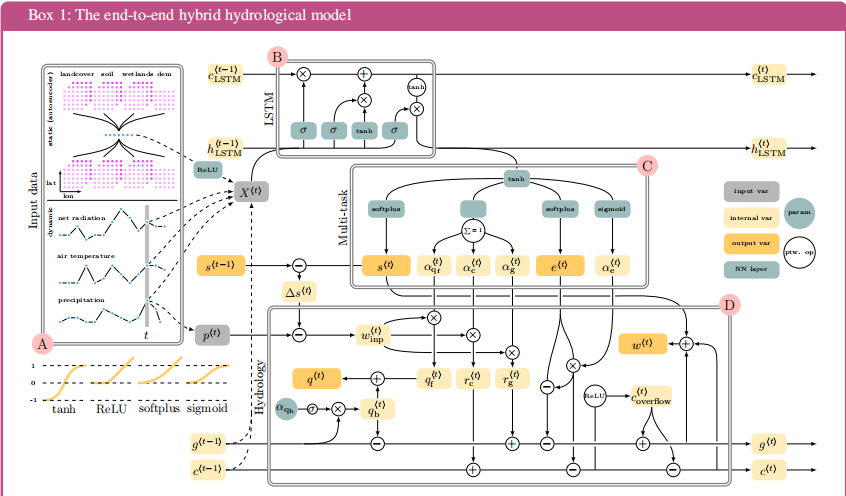 The end-to-end hybrid hydrological model
Creative points
- A physical state $s_{t-1}$ is taken into the recurrent neural network $ g_{RNN} $ for accounting memory effects.
-
A mapping output function $g_{out}$ that links certain latent variable or coefficient $p_{t}$ in process-based models with $h_{t}$
-
The process-based model $f_{pb}$ considers not only original physical constraints $s_{t}$, but also memory effects from RNN.
Comparisons with others
- H2M
- Pros
- hard physical constraints
- additional insights of latent variables and coefficients
- partial interpretability
- Cons
- qunatification of uncertainties
- Generalizability needs to be investigated in certain cases
- Pros
- Regularization via loss functions (soft constriants)
- penalizing physically inconsistent results
- Pros
- additional means in diagosing physical inconsistency
- Cons
- penalizing physically inconsistent results does not always make sense
- lacks of hard physical constraints
- no insights via latent variables and coefficients
- Mass conserving neural networks (hard constraints)
- adding inductive biase
- Pros
- enhances robustness and generalizability
- good performance in extreme events
- Cons
- does not outperform non-mass conserving architecture
- limited interpretability
- Data assimilation
- combining simulations from process-based models and obervation for the optimal estimates of geophysical states
- Pros
- aim to quantify errors
- Cons
- remaining model errors
Personal Opinions
- Compared to physics-constrained machine learning2, using neural networks to replace empirical parameter, it steps further in linking RNNs with latent variables (coefficients) in process-based models, which further taps the potential of AI.
- A question is why acknowledge latent variables (coefficients) activated by softplus function after LSTM layer as Evapotranspration and snow water equvilatent in multi-task layerhttps://ieeexplore.ieee.org/document/8578879, and how to figure out its effect.
Footnote
-
Deep learning and hybrid modeling of global vegetation and hydrology. Basil Kraft. 2022. ↩
-
Zhao, W. L., Gentine, P., Reichstein, M., Zhang, Y., Zhou, S., Wen, Y., et al. (2019). Physics-constrained machine learning of evapotranspiration. Geophysical Research Letters, 46, 14496–14507. https://doi.org/10.1029/2019GL085291 ↩